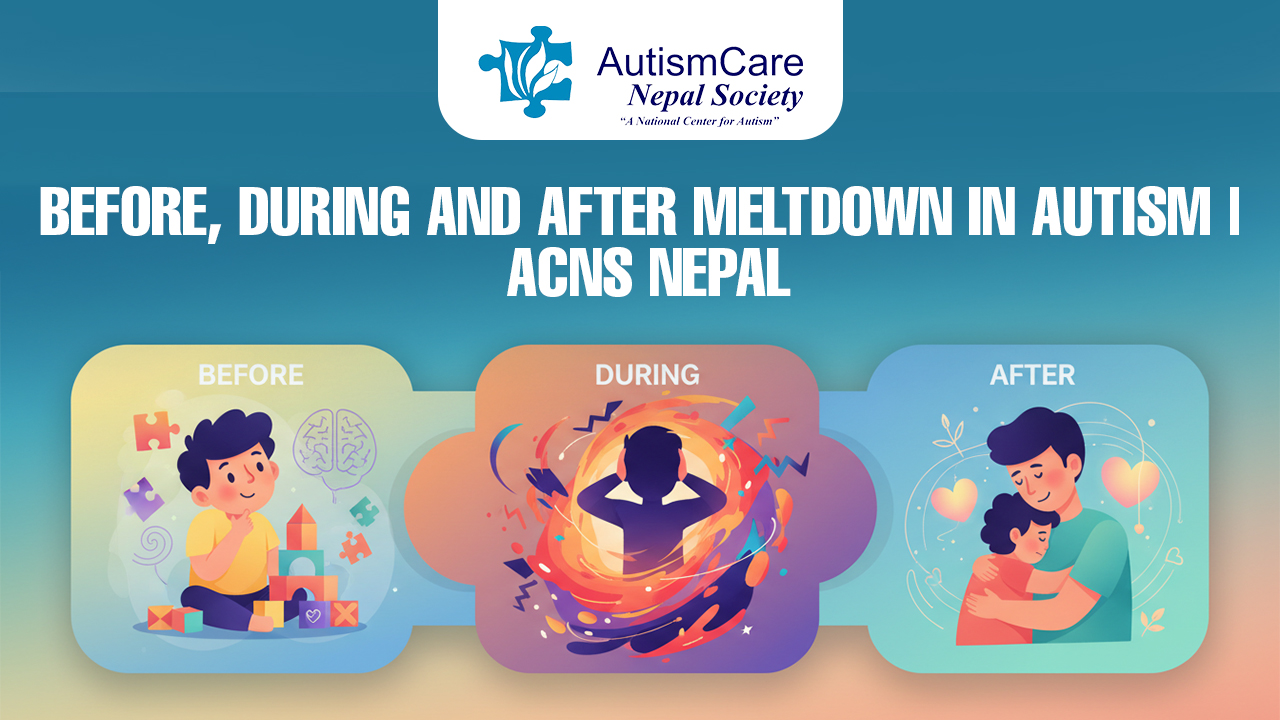
A Meltdown in Autism can feel sudden, but it usually follows a pattern: stress builds, the nervous system overloads, and the person loses the ability to self-regulate for a period of time. The best outcomes come from responding before the peak, staying calm and safe during the meltdown, and adjusting supports after recovery.
This practical guide is for families and schools in Nepal looking for Autism Care in Nepal, support for Autism Spectrum Disorder, and real-world strategies that work in daily life from home routines to an Autism School in Nepal environment.
Direct definition :
A meltdown in autism is an involuntary loss of behavioral control triggered by overwhelming sensory input, emotional stress, or cognitive demands. It is not a tantrum or deliberate behavior. The most effective support is to reduce stimulation and demands, prioritize safety, use simple communication, and allow recovery time.
Meltdown in Autism:
The National Autistic Society describes a meltdown as an intense response to an overwhelming situation where the person temporarily loses control of behavior. NHS-related guidance similarly emphasizes meltdowns are not tantrums because they are not purposeful or goal-driven.
BEFORE a Meltdown in Autism: prevention that actually works
Prevention is not about “controlling” the person, it’s about reducing overload and building predictable supports.
Step 1: Spot the rumble stage (early warning signs)
Common early signals:
- Increased stimming, pacing, rocking
- Irritability, sudden “stuck” behavior
- Covering ears/eyes, seeking hiding places
- Reduced speech or repetitive phrases
- Refusing transitions
Rumble-stage response (2-minute reset)
- Reduce noise/light
- Pause demands
- Offer water/snack
- Give one simple choice (“quiet corner or outside?”)
- Use a timer or “first–then” cue
Extractable summary
- Catch it early → smaller meltdown
- Early supports beat “discipline” almost every time
Step 2: Build a simple prevention plan (the 6 supports)
Use this checklist at home and in school:
- Predictability: visual schedule, “today plan”
- Transitions: warnings + timer + clear next step
- Sensory toolkit: headphones, cap, fidget, chew (if appropriate), water
- Break skill: teach a break card/gesture/word (“break,” “quiet”)
- Lower language load: fewer questions, simpler instructions
- Recovery breaks: short breaks before overload hits
Table: common trigger → prevention support
| Trigger | Prevention support |
| Noise/crowds | headphones, quiet corner, shorter exposure |
| Sudden change | visual schedule + “change card” + choice |
| Too many steps | one instruction at a time + visuals |
| Waiting/queues | predictable waiting routine + distraction tool |
| Hunger/sleep debt | snack plan + earlier bedtime routine |
Extractable summary
- Prevention = predictability + transition support + sensory tools + break skills
- Recovery breaks reduce frequency and intensity
BEFORE in school: supports for an Autism School in Nepal (and inclusive classrooms)
ACNS describes individualized education planning (IEP) based on functional assessment for intervention programs. These principles translate well into classrooms.
High-impact classroom supports
- Visual instructions (one step at a time)
- Reduced verbal overload (don’t talk over distress)
- Quiet corner / safe pass
- Movement breaks scheduled (not only as “reward”)
- Transition cues (timer, 2-minute warning, helper role)
Mini school script (teacher)
- “I see it’s too loud.”
- “You can use your break card.”
- “Quiet corner or outside?” (two options only)
Extractable summary
- Functional assessment + IEP planning helps reduce triggers in school
- Simple language + predictable breaks prevent escalation
DURING a Meltdown in Autism: the safest response
During the peak, the brain is in fight/flight/freeze mode. Reasoning, lectures, and threats usually backfire.
The CALM protocol for de-escalation
C — Create safety
- Move hazards away
- Give space; reduce crowding
- If in public, guide to quieter spot when possible
A — Adjust the environment
- Lower noise/light
- Reduce touch unless the person clearly prefers pressure
- Remove extra demands
L — Limit language
- Use short phrases: “You’re safe.” “I’m here.”
- Avoid “Why are you doing this?”
M — Maintain time for recovery
- Expect recovery to take time
- Don’t force eye contact, apologies, or explanations immediately
This aligns with practical meltdown guidance that recommends making space and reducing overload.
What NOT to do (common mistakes)
- Don’t argue, bargain, or “debate feelings”
- Don’t punish during peak meltdown
- Don’t add more people talking at once
- Don’t record videos or shame (this increases stress)
Extractable summary
- During meltdown: safety + reduced stimulation + minimal language
- The goal is recovery, not “winning”
DURING in public (Nepal-specific realities)
In Nepal, meltdowns often happen in:
- hospitals/queues
- weddings/festivals
- crowded transport/roads
- shopping areas
Quick public checklist
- Turn body sideways (less confrontational)
- Ask others politely to give space
- Move to a wall/corner or outside
- Use a familiar item (headphones, scarf, fidget)
- Keep your voice low and slow
“In public, the fastest de-escalation tool is reducing attention and stimulation—not explaining the diagnosis.”
summary
- Reduce crowd attention + sensory input → faster calm
AFTER a Meltdown in Autism: recovery, learning, and prevention upgrades
After a meltdown, the nervous system is drained. This is the phase where you build long-term improvement without blame.
The RESTORE process (numbered, practical)
- Recovery first: water, snack, quiet activity, rest
- Stabilize routine: return to predictable steps
- Observe patterns: what happened before it started?
- Reflect later (briefly): “Next time we’ll take a break sooner.”
- Tune supports: update schedule, reduce triggers, add break skill practice
- Record a simple log: time, place, trigger, support that helped
- Rehearse prevention: practice transitions and break requests when calm
Extractable summary
- After meltdown: recover → review triggers → adjust plan → practice skills
- Don’t force “discussion” during exhaustion
One-page meltdown plan (home + school)
Use this as a shared plan for parents, teachers, and caregivers.
BEFORE
- Top triggers: __________
- Early warning signs: __________
- Prevention supports: schedule / timer / break card / toolkit
- Safe space location: __________
DURING
- Safety steps: clear area, reduce crowd
- Communication: 5 words or less
- Preferred calming support: quiet / pressure / music / walk (choose what fits the child)
AFTER
- Recovery routine: water + snack + quiet time
- Review time: later (same day or next day)
- Update plan: change one thing at a time
Autism Care in Nepal: ACNS support
Autism Care Nepal Society (ACNS) is a parent-led nonprofit in Nepal, founded on 2 April 2008 (World Autism Awareness Day).
Intervention approach
ACNS describes Functional Assessment and Individualized Educational Plan (IEP)-based interventions and early intervention programs (including special needs education, behavior therapy, communication therapies, occupational therapy, sensory integration therapy, and more).
Autism School in Nepal (ACNS)
ACNS also publishes information about Aarambha Pre-Primary School as a dedicated early support setting and notes structured IEP/progress reporting processes.
“Meltdown plans work best when assessment, school supports, and parent strategies use the same language and the same steps.”
FAQ (optimized for featured snippets)
1) What is “Meltdown in Autism”?
A Meltdown in Autism is an involuntary overwhelm response where an autistic person temporarily loses behavioral control due to sensory, emotional, or cognitive overload. It is not deliberate behavior and improves fastest with safety, reduced stimulation, and recovery time.
2) What should parents do before a meltdown?
Watch for early warning signs (rumble stage), reduce demands, use a timer for transitions, offer a break card, and lower sensory input. Prevention works best when routines are predictable and breaks happen before overload peaks.
3) What is the best thing to do during a meltdown?
Prioritize safety and reduce stimulation: create space, limit language, avoid arguing, and allow time to recover. Practical guidance emphasizes making space and reducing information overload.
4) What should we do after a meltdown?
Focus on recovery first (quiet, water/snack), then review triggers later and adjust supports (visual schedules, sensory tools, transition planning). Avoid punishment during recovery.
5) Meltdown vs tantrum how can I tell?
A tantrum is usually goal-driven and stops when the goal is met; a meltdown is overwhelm-driven and continues until the nervous system recovers. NHS guidance stresses meltdowns are not purposeful tantrums.
6) Can schools prevent meltdowns?
Yes. Visual routines, predictable transitions, quiet spaces, and individualized supports (like IEP-based planning) reduce overload and improve regulation.
7) Where can I get Autism Care in Nepal?
ACNS provides assessment/diagnosis and intervention planning (functional assessment and IEP-based programs) for Autism in Nepal.
8) Do meltdowns mean autism is getting worse?
Not necessarily. Meltdowns often mean demands exceed capacity in that moment (sleep debt, sensory overload, change). With better support, frequency and intensity can reduce over time.
Actionable conclusion: your 3-part plan (Before, During, After)
If you remember only one thing, remember this: meltdowns are communication through overload. Your response should reduce overload and build future capacity.
Summary points
- Before: predictability + transition tools + sensory supports + break skills
- During: safety + reduce stimulation + minimal language + time (
- After: recover first → review triggers later → adjust plan → practice skills
For families seeking Autism Care in Nepal, ACNS lists assessment and intervention pathways with developmental pediatrics and psychology support.