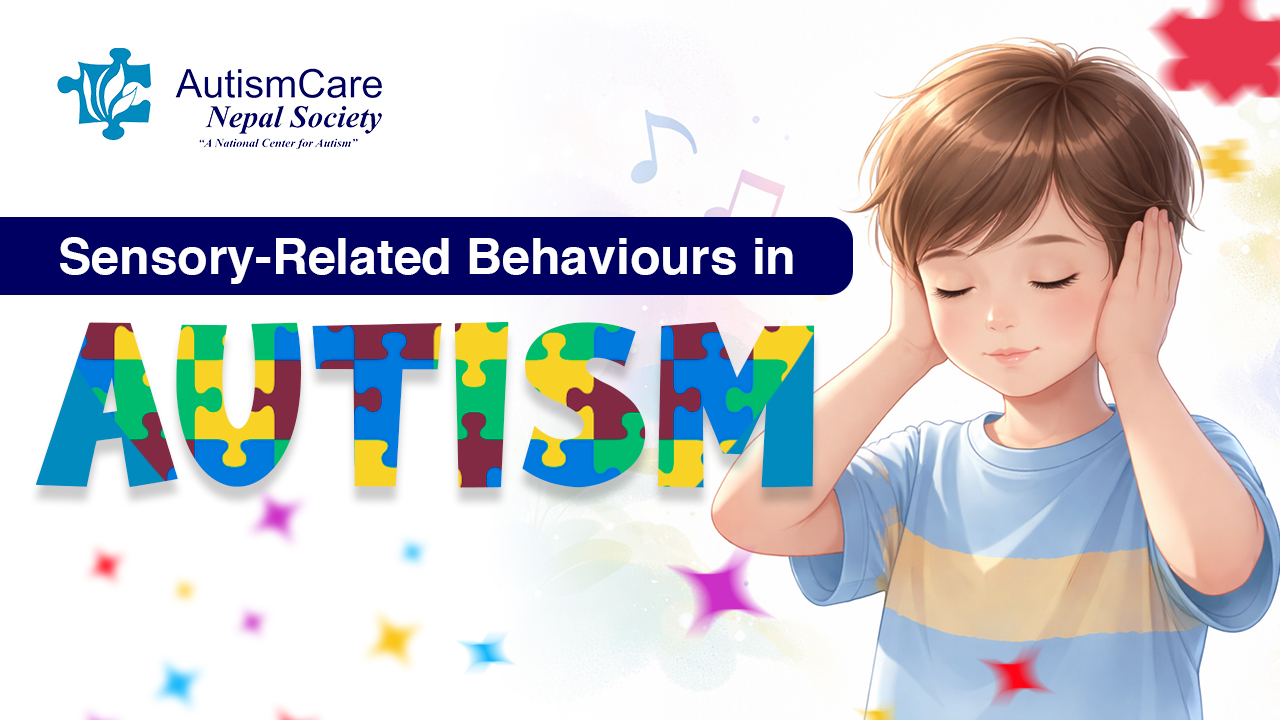
Autism is not defined by a single trait or behaviour. It is a neurodevelopmental condition that affects how individuals perceive, process, and respond to the world around them. Among the most commonly observed and often misunderstood features of autism are sensory-related behaviours.
Understanding Sensory-Related Behaviours in Autism is essential for parents, educators, healthcare professionals, and communities, especially in contexts like Autism in Nepal, where awareness is growing but misconceptions still persist.
This article provides a clear, evidence-based, and human-first explanation of sensory-related behaviours in autism, why they occur, how they affect daily life, and how supportive environments and services such as those offered by Autism Care Nepal Society play a crucial role in inclusion and care.
What Are Sensory-Related Behaviours?
Sensory-related behaviours are responses to sensory input information received through the senses:
- Sight
- Sound
- Touch
- Taste
- Smell
- Movement (vestibular sense)
- Body position (proprioception)
In autistic individuals, the brain may process sensory information differently, leading to heightened or reduced responses.
These behaviours are neurological, not intentional or behavioural problems.
Autism and Sensory Processing: The Clinical Perspective
Research indicates that over 90% of individuals on the autism spectrum experience some form of sensory processing difference. These differences are now formally recognized in diagnostic frameworks.
Sensory processing differences may involve:
- Hyper-responsiveness (over-sensitivity)
- Hypo-responsiveness (under-sensitivity)
- Sensory seeking behaviours
An individual may experience more than one type simultaneously, and responses can change over time or across environments.
Types of Sensory-Related Behaviours in Autism
1. Sensory Over-Responsiveness (Hypersensitivity)
In hypersensitivity, the nervous system reacts too strongly to sensory input.
Examples include:
- Covering ears in response to normal sounds
- Discomfort with bright lights
- Avoidance of certain textures or fabrics
- Distress from strong smells
These reactions are not exaggerated responses; they reflect genuine sensory discomfort or pain.
2. Sensory Under-Responsiveness (Hyposensitivity)
In hyposensitivity, sensory input may be less noticeable.
Examples include:
- Not reacting to loud sounds
- High tolerance for pain or temperature
- Difficulty recognizing hunger or thirst
This can pose safety risks, particularly in unfamiliar environments.
3. Sensory Seeking Behaviours
Some individuals actively seek sensory input to regulate their nervous system.
Examples include:
- Spinning or rocking
- Touching surfaces repeatedly
- Making repetitive sounds
- Seeking pressure (hugging, squeezing objects)
These behaviours often serve a self-regulation function.
Why Sensory-Related Behaviours Occur
Sensory behaviours in autism are linked to differences in brain connectivity and sensory integration.
Key contributing factors include:
- Atypical sensory signal filtering
- Differences in neural response thresholds
- Challenges integrating multiple sensory inputs at once
These neurological differences explain why environments that feel “normal” to some can feel overwhelming or under-stimulating to autistic individuals.
How Sensory Differences Affect Daily Life
Sensory-related behaviours influence many aspects of everyday functioning.
Commonly Affected Areas
- School and learning environments
- Social interactions
- Eating and nutrition
- Sleep patterns
- Public spaces and transportation
For example, a noisy classroom or crowded street may trigger distress not because of fear, but because of sensory overload.
Sensory Meltdowns vs Behavioural Tantrums
One of the most important distinctions to understand is between sensory meltdowns and tantrums.
| Feature | Sensory Meltdown | Tantrum |
| Cause | Sensory overload | Desire for outcome |
| Control | Involuntary | Voluntary |
| Resolution | Needs regulation | Ends when goal achieved |
| Intent | No manipulation | Goal-oriented |
Misinterpreting meltdowns can lead to inappropriate responses and increased distress.
Sensory Processing and Autism in Nepal
In Nepal, awareness of autism has improved over the past decade, but sensory-related behaviours are still frequently misunderstood.
Challenges include:
- Limited public awareness
- Mislabeling behaviours as disobedience
- Lack of sensory-friendly environments
Understanding sensory needs is essential to improving inclusion and care for individuals with Autism in Nepal.
Role of Autism Care Centers in Supporting Sensory Needs
Specialized support plays a critical role in helping autistic individuals manage sensory challenges.
Organizations such as Autism Care Nepal Society contribute by:
- Promoting autism awareness
- Supporting sensory-informed care approaches
- Educating families and communities
- Advocating for inclusive environments
Such efforts help normalize sensory differences rather than suppress them.
Sensory Integration and Support Strategies
While sensory differences cannot be “cured,” supportive strategies can improve comfort and participation.
Common Support Approaches
- Structured routines
- Sensory breaks
- Environmental modifications
- Use of sensory tools (ear defenders, weighted items)
Interventions are most effective when tailored to the individual’s sensory profile.
Importance of Individualized Assessment
No two autistic individuals have the same sensory experience.
Assessment may involve:
- Observations across settings
- Caregiver input
- Professional evaluation
Understanding specific triggers and preferences allows for predictable and supportive environments.
Sensory-Friendly Environments: Why They Matter
Sensory-friendly spaces reduce unnecessary stress and improve engagement.
Examples include:
- Reduced noise levels
- Soft lighting
- Clear visual structure
- Quiet spaces for regulation
These adjustments benefit not only autistic individuals but many others as well.
Evidence-Based Understanding of Sensory Behaviours
Scientific studies consistently show that:
- Sensory processing differences are neurologically based
- Suppressing sensory behaviours can increase anxiety
- Supportive environments improve participation and well-being
Modern autism care emphasizes accommodation over correction.
Addressing Myths Around Sensory Behaviours
Common Myths
- “They will outgrow it.”
- “They are doing it for attention.”
- “Strict discipline will stop it.”
Evidence-Based Reality
- Sensory differences may change but often persist
- Behaviours serve a regulatory purpose
- Understanding and support reduce distress
Replacing myths with knowledge leads to better outcomes.
Supporting Families and Caregivers
Families play a central role in supporting sensory needs.
Helpful steps include:
- Learning individual sensory triggers
- Advocating for accommodations
- Seeking professional guidance when needed
- Connecting with support networks
Community education reduces isolation and stigma.
Medical & Professional Review Note
This article is written for educational and awareness purposes. Sensory-related behaviours in autism should be understood within a neurodevelopmental framework. Assessment and support planning should involve qualified professionals experienced in autism care.
Frequently Asked Questions (FAQ)
Are sensory-related behaviours present in all autistic individuals?
Most, but not all, autistic individuals experience sensory processing differences to some degree.
Are sensory behaviours a sign of poor behaviour?
No. They are neurological responses, not intentional misbehaviour.
Can sensory issues improve over time?
Some individuals develop coping strategies, but sensory differences may persist.
Is sensory integration therapy helpful?
It may be beneficial for some individuals when guided by trained professionals.
Where can families seek autism support in Nepal?
Organizations such as Autism Care Nepal Society support awareness and services related to autism.
Final Thoughts
Sensory-Related Behaviours in Autism are not problems to be fixed they are signals to be understood. When communities recognize sensory differences as part of human diversity, inclusion becomes possible.
In Nepal, increasing awareness, supportive care models, and community engagement are essential for improving the lives of individuals with autism and their families. Understanding sensory behaviours is a meaningful step toward acceptance, dignity, and support.
Repetitive and Restricted Behaviours in Autism
Repetitive and restricted behaviours are a core characteristic of autism spectrum disorder (ASD). They are not random habits or bad behavior. Instead, they reflect how the autistic brain processes information, manages sensory input, and finds predictability in the environment.
This article explains repetitive behaviours in autism and restricted behaviours in autism in a clear, evidence-based way, with context relevant to autism in Nepal, especially for families in Kathmandu and Lalitpur.
The intent is purely informational and awareness-focused.
Understanding Autism Spectrum Disorder (ASD)
Autism spectrum disorder is a neurodevelopmental condition that affects:
- Social communication
- Behavior patterns
- Sensory processing
According to international diagnostic guidelines (DSM-5), autism is defined by two main domains:
- Social communication differences
- Restricted and repetitive patterns of behaviour
This article focuses on the second domain.
What Are Repetitive Behaviours in Autism?
Repetitive behaviours in autism are actions, movements, or speech patterns that are repeated in a consistent way.
These behaviours often serve a purpose for the individual, such as:
- Self-regulation
- Reducing anxiety
- Sensory stimulation
- Predictability and comfort
They are commonly referred to as “stimming” (self-stimulatory behaviors).
Common Examples of Repetitive Behaviours
- Hand flapping
- Rocking back and forth
- Spinning objects
- Repeating words or phrases (echolalia)
- Lining up toys or objects
These behaviours may increase during stress, excitement, or sensory overload.
What Are Restricted Behaviours in Autism?
Restricted behaviours in autism refer to a limited range of interests, activities, or routines that are followed rigidly.
These are not simply strong preferences.
They are deeply rooted patterns that help the person feel safe and organized.
Common Restricted Behaviour Patterns
- Intense focus on specific topics (e.g., vehicles, numbers, maps)
- Strong resistance to changes in routine
- Eating only specific foods
- Wearing the same clothes repeatedly
- Distress when familiar patterns are disrupted
Repetitive vs Restricted Behaviours: Key Differences
| Aspect | Repetitive Behaviours | Restricted Behaviours |
| Nature | Repeated actions or movements | Limited interests or routines |
| Purpose | Sensory or emotional regulation | Predictability and control |
| Examples | Hand flapping, echolalia | Fixed routines, narrow interests |
| Flexibility | May vary with mood | Often rigid and inflexible |
Both are essential diagnostic features of autism.
Why Do These Behaviours Occur?
Research suggests several contributing factors:
- Differences in brain connectivity
- Sensory processing differences
- Difficulty with uncertainty and transitions
- Neurological regulation mechanisms
These behaviours are not caused by parenting style, discipline, or emotional trauma.
Are Repetitive and Restricted Behaviours Harmful?
Not always.
Many repetitive behaviours are:
- Harmless
- Self-soothing
- Important for emotional regulation
However, intervention may be needed if behaviours:
- Interfere with learning
- Cause physical harm
- Limit daily functioning
- Create safety concerns
The goal is support, not elimination.
Autism in Nepal: Current Awareness Context
In Nepal, awareness about autism is improving, but misunderstandings remain.
Common challenges include:
- Late identification
- Limited access to early intervention
- Social stigma
Organizations such as Autism Care Nepal Society (ACNS) play an important role in awareness, education, and family support related to autism in Nepal.
Supporting Individuals with Repetitive and Restricted Behaviours
Evidence-based approaches focus on understanding the function of the behaviour.
Support strategies may include:
- Structured routines
- Visual schedules
- Sensory integration strategies
- Behavioral and developmental therapies
Support should always be individualized and respectful.
What Parents and Caregivers Should Know
- These behaviours are part of autism, not defiance
- Forcing suppression can increase anxiety
- Understanding triggers helps reduce distress
- Professional guidance improves outcomes
Early support leads to better adaptive skills over time.
Frequently Asked Questions (FAQ)
Are repetitive behaviours unique to autism?
No, but their frequency, intensity, and function are distinct in autism.
Do all autistic individuals have restricted behaviours?
Most do, but the type and intensity vary widely.
Can these behaviours go away with age?
Some change over time, especially with support, but many remain part of self-regulation.
Should stimming be stopped?
Only if it causes harm or prevents learning. Otherwise, it is usually allowed.
Where can families in Nepal seek guidance?
Specialized autism organizations and developmental professionals provide support and education.
Medical / Professional Review Note
This article is based on current diagnostic criteria, peer-reviewed autism research, and established developmental psychology guidelines. It is intended for educational purposes only and does not replace clinical diagnosis or individualized therapy planning.