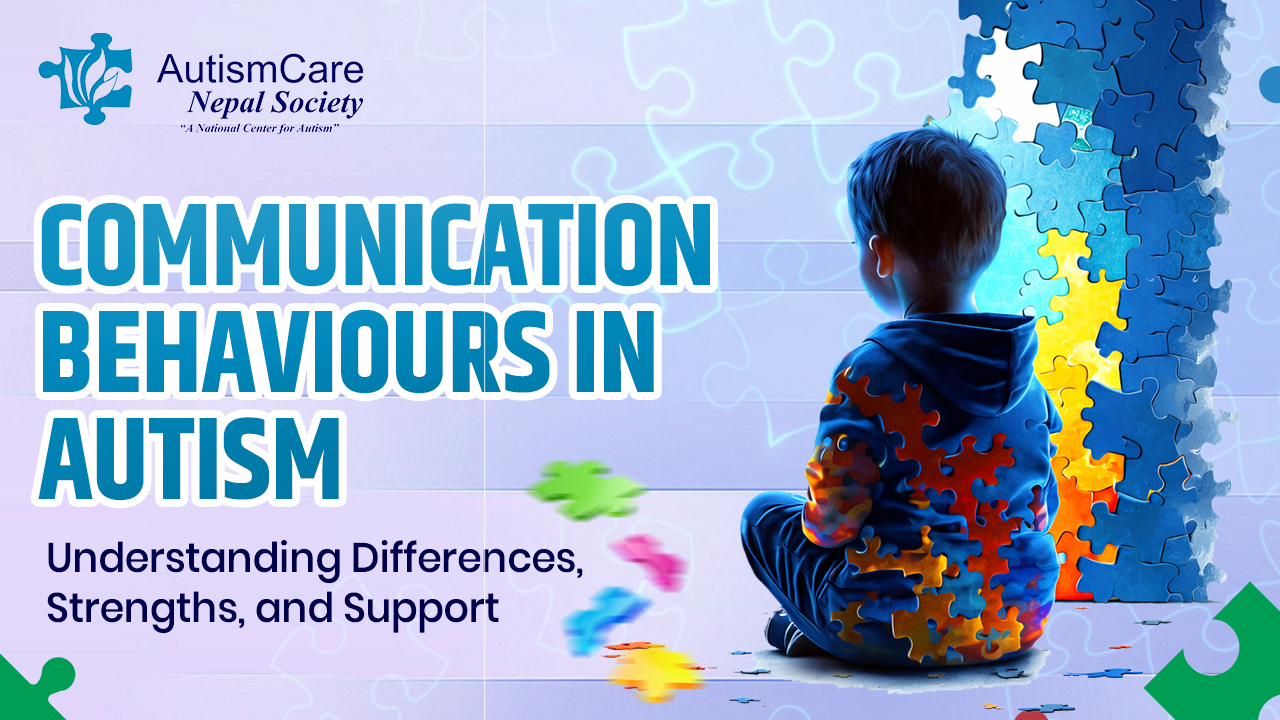
Behaviours in autism can include differences in communication, social interaction, sensory responses, routines, play, learning, and emotional regulation. When families search for communication behaviours in autism, they are usually trying to understand why an autistic child may not speak, repeat words, avoid eye contact, communicate through gestures, use behaviour to express needs, or become overwhelmed in social situations.
Autism is a developmental condition related to the brain. The World Health Organization describes autism as involving differences in social interaction and communication, along with patterns of behaviour such as difficulty with transitions, strong attention to details, and unusual sensory responses.
The goal is not to “fix” autistic communication. The goal is to understand each person’s communication style, reduce barriers, and provide respectful support.
What Are Communication Behaviours in Autism?
Communication behaviours in autism are the different ways autistic people express needs, emotions, thoughts, discomfort, joy, confusion, or stress.
Some autistic people speak fluently. Some use a few words. Some communicate with gestures, writing, pictures, sounds, body movement, assistive technology, or behaviour.
| Communication Behaviour | What It May Mean |
| Limited speech | The person may need another way to communicate |
| Repeating words or phrases | May be communication, processing, comfort, or learning |
| Avoiding eye contact | May help reduce sensory or social pressure |
| Pulling a parent’s hand | May be a request for help or access |
| Meltdown or distress | May show overwhelm, pain, fear, or unmet need |
| Using pictures or AAC | A valid communication method |
| Talking mainly about one topic | May show deep interest, comfort, or connection |
| Not responding to name | May reflect attention, sensory processing, or language difference |
The most helpful response is curiosity: “What is this person trying to communicate?”
What Does Autism Mean?
Autism, also called Autism Spectrum Disorder, is a lifelong neurodevelopmental difference. It affects how a person experiences the world, communicates, learns, responds to sensory input, and interacts with others.
The word “spectrum” does not mean a line from mild to severe. It means autistic people have different combinations of strengths, needs, communication styles, sensory responses, and support requirements.
The National Autistic Society explains that autistic people may use and understand words, tone of voice, body language, gestures, and facial expressions differently. Some autistic people may have limited, unreliable, intermittent, or no speech and may communicate through writing, signs, gestures, sounds, picture cards, or Augmentative and Alternative Communication, also called AAC.
This is why communication support should be individual. Two autistic children of the same age may need very different strategies.
Why Communication Behaviours in Autism Are Often Misunderstood
Many behaviours in autism are misunderstood because people focus only on what they see.
For example, a child who screams in a classroom may be called “naughty.” But the real reason may be sound sensitivity, confusion, difficulty asking for help, pain, fear, or too many instructions at once.
A child who does not answer a question may not be ignoring the adult. They may need more processing time, may not understand the question, or may not be able to respond with speech at that moment.
A person who repeats the same sentence may be using echolalia to communicate, regulate emotions, remember language, or participate in conversation.
When behaviour is treated as communication, support becomes more respectful and effective.
Common Communication Behaviours in Autism
1. Delayed Speech or Limited Spoken Language
Some autistic children start speaking later than other children. Some may use single words, short phrases, or scripts from songs, videos, or family routines.
Delayed speech does not mean the child has nothing to say. It means they may need support to express themselves.
Support may include speech-language therapy, play-based interaction, visual supports, sign support, picture cards, or AAC.
2. Echolalia or Repeating Words
Echolalia means repeating words or phrases heard before. It may happen immediately or later.
Examples include:
| Type | Example |
| Immediate echolalia | An adult says “Do you want water?” The child repeats “want water?” |
| Delayed echolalia | Child repeats a line from a cartoon during play |
| Functional echolalia | Child says a memorised phrase to request something |
| Self-regulatory echolalia | Child repeats words to stay calm |
Echolalia should not automatically be stopped. It can be a bridge toward meaningful communication.
3. Different Eye Contact
Many autistic people find eye contact uncomfortable, distracting, or overwhelming. Some can listen better when they are not looking directly at someone.
Forcing eye contact can increase stress. A better goal is shared attention, comfort, and understanding.
A child can listen while looking away, playing with an object, or moving.
4. Gestures, Pulling, Pointing, or Leading
Some autistic children communicate by pulling an adult’s hand, pointing, reaching, giving an object, standing near something, or looking toward what they want.
These are meaningful communication behaviours.
Adults can support this by adding simple words: “You want juice,” “Help open,” or “More bubbles.”
This helps connect the child’s action with language.
5. Reduced Response to Name
Not responding to names is a common concern for parents. It may happen for many reasons, including sensory focus, delayed language processing, deep attention to an activity, or difficulty shifting attention.
It should be discussed with a professional, especially if there are other developmental concerns.
CDC notes that autism can sometimes be detected at 18 months or younger, and by age 2, diagnosis by an experienced professional can be considered reliable.
6. Meltdowns as Communication
A meltdown is not a planned tantrum. It may happen when a person is overwhelmed and cannot cope with the demands, sensory input, pain, or confusion around them.
A meltdown can communicate:
- “This is too loud.”
- “I do not understand.”
- “I need a break.”
- “I am in pain.”
- “I cannot express what I need.”
- “Too many things changed.”
The response should focus on safety, calmness, reducing demands, and understanding the trigger.
7. Behaviour That Looks Like Refusal
Some autistic children may run away, cover ears, drop to the floor, avoid tasks, or say “no” repeatedly.
This may not be a simple refusal. It may show anxiety, sensory overload, motor difficulty, unclear instruction, fear of failure, or lack of communication tools.
Instead of asking “How do we stop this?” ask, “What support does this person need?”
Strengths in Autistic Communication
Autistic communication is often discussed only as a difficulty. That is incomplete.
Many autistic people have strong communication strengths, such as:
| Strength | How It May Appear |
| Honesty | Direct and clear expression |
| Strong memory | Recalling details, facts, routes, or routines |
| Deep interest | Detailed knowledge about preferred topics |
| Visual thinking | Learning well through pictures, patterns, maps, or written instructions |
| Consistency | Communicating best through predictable routines |
| Pattern recognition | Noticing details others miss |
| Alternative communication | Expressing through art, music, typing, movement, or AAC |
Recognising strengths helps families and teachers build confidence instead of focusing only on deficits.
How Autism Can Affect Communication Skills
Autism may affect both expressive and receptive communication.
Expressive communication means how a person shares messages. This includes speech, gestures, writing, AAC, facial expression, pointing, or behaviour.
Receptive communication means how a person understands messages. This includes understanding words, tone, body language, questions, instructions, and social meaning.
| Area | Possible Difference |
| Understanding language | Difficulty following long or abstract instructions |
| Using speech | Delayed speech, scripted speech, or few words |
| Conversation | Difficulty starting, continuing, or ending conversations |
| Social cues | Difficulty reading facial expressions, tone, or indirect meaning |
| Processing time | Needing longer to understand and respond |
| Sensory input | Noise, light, touch, or crowds interfering with communication |
| Emotional regulation | Stress reducing ability to communicate clearly |
CDC states that autistic people often have differences in social communication and interaction, restricted or repetitive behaviours or interests, and different ways of learning, moving, or paying attention.
Communication Is More Than Speech
A common mistake is thinking that speech equals communication.
Speech is only one method. Communication also includes:
- Looking
- Pointing
- Reaching
- Moving away
- Smiling
- Crying
- Typing
- Drawing
- Using pictures
- Using a device
- Taking someone to an object
- Repeating phrases
- Choosing between options
For some autistic people, spoken language is unreliable. They may speak on some days but not others, or speak well about favourite topics but struggle to ask for help.
Support should respect all valid communication.
Autism in Nepal: Why Awareness Matters
Families searching for autism in Nepal often face delayed diagnosis, limited awareness, stigma, school barriers, and difficulty finding trained support.
AutismCare Nepal Society, also known as ACNS, describes itself as a parent-led nonprofit supporting autistic individuals and their families across Nepal. Its website states that ACNS has supported families since 2008 and works toward education, support services, advocacy, awareness, inclusion, and improved quality of life.
There is no single, regularly updated national autism registry publicly used like some countries have. WHO estimated that in 2021 about 1 in 127 persons had autism globally. Nepal’s 2025 total population is listed by UNFPA as about 29.6 million, so applying the WHO global estimate gives a rough estimate of around 233,000 autistic people in Nepal; this is only an approximation, not a Nepal-specific diagnosis count.
ACNS also highlights “300,000+ children with autism in Nepal” on its website, which reflects the scale of concern and need for services, but Nepal still needs stronger official data and accessible diagnosis systems.
Autism School in Nepal: What Families Should Look For
When parents search for an autism school in Nepal, they are usually looking for a safe learning environment where their child will be understood.
A good autism-supportive school or early learning program should provide:
| Feature | Why It Matters |
| Individual plan | Every autistic child has different needs |
| Visual supports | Helps understanding and transitions |
| Trained teachers | Reduces punishment-based responses |
| Communication support | Builds speech, AAC, gestures, or functional communication |
| Sensory-friendly routines | Reduces overwhelm |
| Parent involvement | Helps skills carry over at home |
| Progress tracking | Shows what is improving and what needs adjustment |
AutismCare Nepal Society lists services and supports including Aarambha Pre Primary School, assessment and diagnosis, occupational therapy, counselling, music therapy, and vocational support.
For families, the best setting is one that respects the child, communicates with parents, and supports learning without forcing masking or causing distress.
Autism Care Center in Nepal: What Support May Include
An autism care center in Nepal may provide different types of support depending on the child’s age, needs, communication level, sensory profile, and family goals.
Support may include:
- Developmental assessment
- Parent counselling
- Speech and communication support
- Occupational therapy
- Sensory regulation support
- Behaviour support
- Early intervention
- School readiness
- Social communication support
- Daily living skills
- Family training
- Vocational preparation for older individuals
WHO states that evidence-based psychosocial interventions can improve communication and social skills and positively affect the well-being and quality of life of autistic people and caregivers.
The best support plan is not the same for every person. It should be individual, respectful, practical, and reviewed over time.
Practical Ways Parents Can Support Communication at Home
1. Observe Before Correcting
Before stopping a behaviour, observe it.
Ask:
- What happened before the behaviour?
- What did the child gain or avoid?
- Was the environment too loud or crowded?
- Was the instruction too difficult?
- Did the child have a way to ask for help?
This helps families respond to the cause, not only the visible behaviour.
2. Use Simple, Clear Language
Many autistic children understand better when language is short and concrete.
Instead of saying:
“Why don’t you get ready quickly because we are already late?”
Say:
“Shoes on. Then the car.”
Short instructions reduce confusion.
3. Give Processing Time
After asking a question, pause. Some autistic people need extra time to understand and respond.
Avoid repeating the same question many times quickly. That can increase pressure.
A quiet pause can be more helpful.
4. Use Visual Supports
Visual supports can include:
- Picture cards
- Daily routine charts
- First–then boards
- Emotion cards
- Choice boards
- Written instructions
- Calendar plans
- Social stories
Visuals help because they stay in place. Spoken words disappear quickly.
5. Offer Choices
Choices increase communication.
Examples:
- “Apple or banana?”
- “Red shirt or blue shirt?”
- “Read books or blocks?”
- “Walk or bus?”
For children who do not speak, they can point, reach, look, or use picture cards.
6. Accept All Communication
If a child communicates by pointing, pulling, showing, typing, or using AAC, accept it.
Do not demand speech before meeting a need.
You can model words without pressure: “Water. You want water.”
7. Reduce Sensory Overload
Communication becomes harder when the body is overwhelmed.
Helpful changes may include:
- Reducing background noise
- Dimming bright lights
- Giving movement breaks
- Creating a quiet corner
- Using headphones if tolerated
- Preparing the child before transitions
- Avoiding crowded spaces when possible
Sensory support often improves communication because the child feels safer.
How Teachers Can Support Autistic Communication
Teachers play a major role in communication success.
Useful classroom supports include:
| Classroom Strategy | Benefit |
| Visual timetable | Helps students know what comes next |
| Clear classroom rules | Reduces uncertainty |
| Break cards | Lets students ask for a break safely |
| Choice boards | Supports participation |
| Peer awareness | Reduces bullying and misunderstanding |
| Calm corner | Helps self-regulation |
| Short instructions | Improves understanding |
| Written reminders | Supports memory and independence |
Teachers should avoid shaming a child for not speaking, avoiding eye contact, moving, stimming, or needing breaks.
Inclusion works best when the environment adapts too.
When Should Parents Seek an Autism Assessment?
Parents should consider a professional assessment if a child shows several signs such as:
- Not responding to name consistently
- Delayed speech or loss of words
- Limited pointing or gestures
- Repetitive movements
- Strong distress with changes
- Limited pretend play
- Unusual sensory responses
- Difficulty interacting with peers
- Repeating words without flexible use
- Intense focus on specific objects or routines
Mayo Clinic notes that signs of autism are often seen by ages 2 to 3, though some signs may appear earlier, and families should talk with a healthcare professional if they are concerned about development.
Early support can help communication, learning, independence, and family confidence.
What Causes Autism?
Autism does not have one single known cause.
CDC explains that many factors may make a child more likely to have autism, including genetic, biological, and environmental factors. Mayo Clinic similarly states that autism has no single known cause and that both genetics and environment may play a role.
Research suggests genetics play a major role. Large studies have estimated autism heritability at around 80% or higher, but heritability does not mean autism is caused by one gene or that environment is irrelevant.
The most accurate message for families is: autism is complex, biological, and not caused by poor parenting.
Support Approaches for Communication Behaviours in Autism
There is no one “best” therapy for every autistic person. Support should be based on assessment, strengths, family priorities, communication needs, sensory profile, and daily life goals.
| Support Type | How It Helps |
| Speech-language support | Builds communication, understanding, speech, AAC, or social communication |
| Occupational therapy | Supports sensory needs, daily living skills, regulation, and motor skills |
| Parent-mediated support | Teaches caregivers strategies for daily routines |
| AAC | Gives non-speaking or unreliable-speaking people a communication system |
| Developmental play-based support | Builds interaction through natural play |
| Behaviour support | Understands triggers and teaches safer communication alternatives |
| Inclusive education support | Helps learning, participation, and peer interaction |
| Counselling and family support | Reduces stress and builds confidence |
CDC states that current autism treatments aim to reduce symptoms that interfere with daily functioning and quality of life, and that treatment plans are usually individualised and involve multiple professionals.
What Not to Do
Some responses can make communication harder.
Avoid:
- Forcing eye contact
- Punishing stimming automatically
- Removing AAC to force speech
- Ignoring sensory distress
- Calling the child lazy or rude
- Comparing one autistic child with another
- Expecting speech before meeting basic needs
- Using shame as discipline
- Treating meltdowns as intentional misbehaviour
- Believing “one therapy works for all”
Respectful support begins with understanding.
Myths and Facts About Behaviours in Autism
| Myth | Fact |
| Autistic children do not want to communicate | Many do communicate, but in different ways |
| No speech means no understanding | Understanding and speech are different skills |
| Eye contact means listening | Some autistic people listen better without eye contact |
| Repetition is meaningless | Echolalia can have communication value |
| Behaviour is always bad behaviour | Behaviour may express stress, need, pain, or confusion |
| Autism can be cured | Autism is lifelong; support can improve skills and quality of life |
| All autistic people are the same | Every autistic person has a different profile |
FAQs About Communication Behaviours in Autism
How many people are autistic in Nepal?
Nepal does not have a widely used official national autism registry. Using WHO’s global estimate of about 1 in 127 people and Nepal’s 2025 population of about 29.6 million, a rough estimate is around 233,000 autistic people in Nepal. This is an estimate, not an official diagnosis count.
What is 90% of autism caused by?
It is not accurate to say 90% of autism is caused by one thing. Research shows autism is highly influenced by genetics, with some studies estimating heritability around 80% or more, but autism involves many genetic, biological, and environmental factors.
Can a person with autism live a normal life?
Yes, many autistic people live fulfilling lives, study, work, build relationships, and participate in society. Support needs vary. Some people live independently, while others need lifelong support. WHO notes that abilities and needs vary and can evolve over time.
Can autistics have high IQ?
Yes. Some autistic people have intellectual disability, some have average intelligence, and some have high intelligence. Mayo Clinic notes that some autistic children usually have usual to high intelligence but may still struggle with communication, applying learning in daily life, or adapting socially.
Do autistic children improve with age?
Many autistic children improve skills with age, support, communication tools, and inclusive environments. Autism itself is lifelong, but communication, independence, emotional regulation, and daily living skills can improve over time. Mayo Clinic notes that children may not outgrow autism symptoms, but they may learn to function well.
What is the best treatment for autism in the world?
There is no single best treatment for everyone. The best support is individualised, evidence-informed, and may include speech-language support, occupational therapy, AAC, parent training, developmental interventions, education support, and help for co-occurring needs. CDC says treatment plans are usually tailored to the individual and involve multiple professionals.
What are common communication challenges for autistic persons?
Common challenges include delayed speech, limited speech, difficulty understanding indirect language, reduced use of gestures, echolalia, difficulty with conversation, sensory overload, trouble reading facial expressions, and needing more processing time.
How can autism affect communication skills?
Autism can affect how a person understands language, uses speech, reads social cues, processes tone and body language, starts conversations, asks for help, and communicates during stress. Some autistic people use AAC, pictures, gestures, writing, or behaviour to communicate.
Key Takeaway
Communication behaviours in autism are meaningful. They may look different from typical communication, but they often express needs, emotions, preferences, discomfort, joy, or overwhelm.
The most helpful approach is not to force autistic people to communicate like everyone else. It is to understand their communication style, support their strengths, reduce barriers, and provide tools that help them participate with dignity.
For families searching for autism in Nepal, an autism school in Nepal, or an autism care center in Nepal, the best next step is to seek guidance from trained professionals and organisations that understand autism, communication differences, and family-centred support.
Author Bio
AutismCare Nepal Society Editorial Team[Text Wrapping Break]This article was prepared by the AutismCare Nepal Society Editorial Team for autism awareness, family education, and inclusive support in Nepal. AutismCare Nepal Society is a parent-led nonprofit supporting autistic individuals and families through education, advocacy, awareness, and support services.