
Repetitive and restricted behaviours are a core characteristic of autism spectrum disorder (ASD). They are not random habits or bad behavior. Instead, they reflect how the autistic brain processes information, manages sensory input, and finds predictability in the environment.
This article explains repetitive behaviours in autism and restricted behaviours in autism in a clear, evidence-based way, with context relevant to autism in Nepal, especially for families in Kathmandu and Lalitpur.
The intent is purely informational and awareness-focused.
Understanding Autism Spectrum Disorder (ASD)
Autism spectrum disorder is a neurodevelopmental condition that affects:
- Social communication
- Behavior patterns
- Sensory processing
According to international diagnostic guidelines (DSM-5), autism is defined by two main domains:
- Social communication differences
- Restricted and repetitive patterns of behaviour
This article focuses on the second domain.
What Are Repetitive Behaviours in Autism?
Repetitive behaviours in autism are actions, movements, or speech patterns that are repeated in a consistent way.
These behaviours often serve a purpose for the individual, such as:
- Self-regulation
- Reducing anxiety
- Sensory stimulation
- Predictability and comfort
They are commonly referred to as “stimming” (self-stimulatory behaviors).
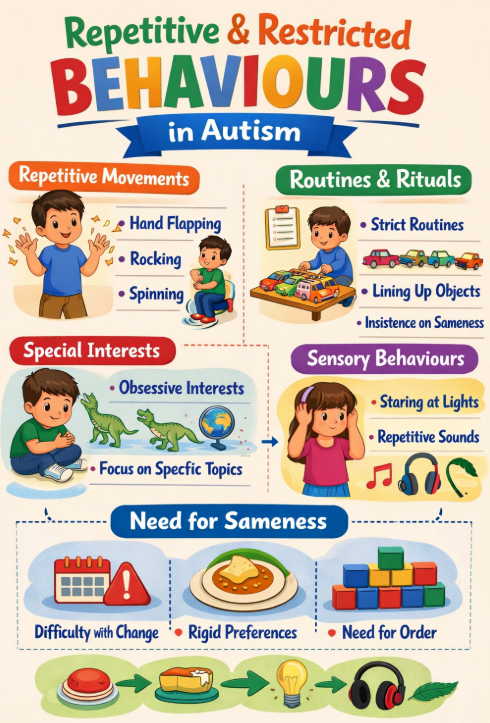
Common Examples of Repetitive Behaviours
- Hand flapping
- Rocking back and forth
- Spinning objects
- Repeating words or phrases (echolalia)
- Lining up toys or objects
These behaviours may increase during stress, excitement, or sensory overload.
What Are Restricted Behaviours in Autism?
Restricted behaviours in autism refer to a limited range of interests, activities, or routines that are followed rigidly.
These are not simply strong preferences.
They are deeply rooted patterns that help the person feel safe and organized.
Common Restricted Behaviour Patterns
- Intense focus on specific topics (e.g., vehicles, numbers, maps)
- Strong resistance to changes in routine
- Eating only specific foods
- Wearing the same clothes repeatedly
- Distress when familiar patterns are disrupted
Repetitive vs Restricted Behaviours: Key Differences
| Aspect | Repetitive Behaviours | Restricted Behaviours |
| Nature | Repeated actions or movements | Limited interests or routines |
| Purpose | Sensory or emotional regulation | Predictability and control |
| Examples | Hand flapping, echolalia | Fixed routines, narrow interests |
| Flexibility | May vary with mood | Often rigid and inflexible |
Both are essential diagnostic features of autism.
Why Do These Behaviours Occur?
Research suggests several contributing factors:
- Differences in brain connectivity
- Sensory processing differences
- Difficulty with uncertainty and transitions
- Neurological regulation mechanisms
These behaviours are not caused by parenting style, discipline, or emotional trauma.
Are Repetitive and Restricted Behaviours Harmful?
Not always.
Many repetitive behaviours are:
- Harmless
- Self-soothing
- Important for emotional regulation
However, intervention may be needed if behaviours:
- Interfere with learning
- Cause physical harm
- Limit daily functioning
- Create safety concerns
The goal is support, not elimination.
Autism in Nepal: Current Awareness Context
In Nepal, awareness about autism is improving, but misunderstandings remain.
Common challenges include:
- Late identification
- Limited access to early intervention
- Social stigma
Organizations such as Autism Care Nepal Society (ACNS) play an important role in awareness, education, and family support related to autism in Nepal.
Supporting Individuals with Repetitive and Restricted Behaviours
Evidence-based approaches focus on understanding the function of the behaviour.
Support strategies may include:
- Structured routines
- Visual schedules
- Sensory integration strategies
- Behavioral and developmental therapies
Support should always be individualized and respectful.
What Parents and Caregivers Should Know
- These behaviours are part of autism, not defiance
- Forcing suppression can increase anxiety
- Understanding triggers helps reduce distress
- Professional guidance improves outcomes
Early support leads to better adaptive skills over time.
Frequently Asked Questions (FAQ)
Are repetitive behaviours unique to autism?
No, but their frequency, intensity, and function are distinct in autism.
Do all autistic individuals have restricted behaviours?
Most do, but the type and intensity vary widely.
Can these behaviours go away with age?
Some change over time, especially with support, but many remain part of self-regulation.
Should stimming be stopped?
Only if it causes harm or prevents learning. Otherwise, it is usually allowed.
Where can families in Nepal seek guidance?
Specialized autism organizations and developmental professionals provide support and education.
Medical / Professional Review Note
This article is based on current diagnostic criteria, peer-reviewed autism research, and established developmental psychology guidelines. It is intended for educational purposes only and does not replace clinical diagnosis or individualized therapy planning.